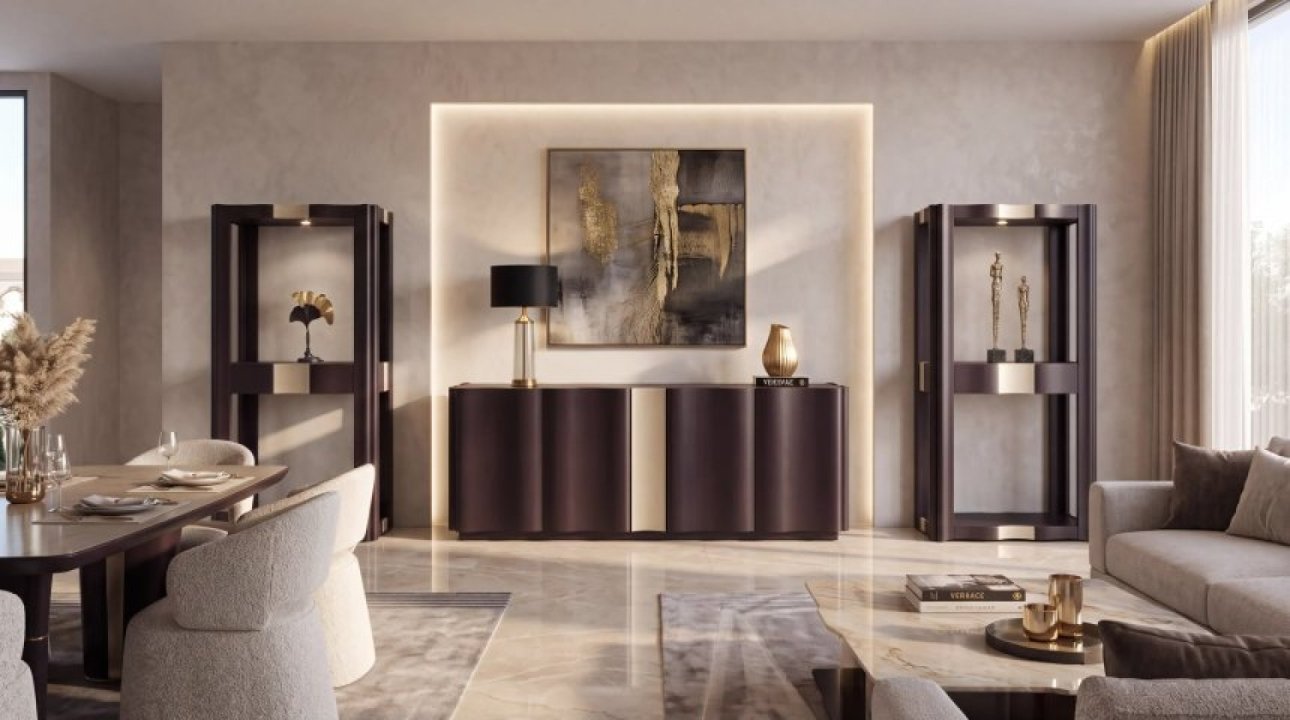
How to choose a sideboard and a display cabinet for the dining or living room: the difference between them, measuring, placement, interior layout and materials.
A sideboard and a display cabinet are often chosen after the dining table, yet they largely decide how tidy the room stays. One gives closed storage and a serving surface; the other protects pieces while showing them. This guide covers the difference between the two, how to measure, where to place them and how to plan the interior.
At STARMOBİ, a manufacturer in production since 1981, the mistake we see most often in the showroom is falling for a model first and thinking about dimensions later. Measuring the wall and the passage space first makes the choice much easier.
Sideboard vs display cabinet
| Criterion | Sideboard | Display cabinet |
|---|---|---|
| Shape | Low and horizontal | Tall and vertical |
| Main job | Closed storage, serving surface | Display, protection from dust |
| Contents | Hidden; conceals clutter | Visible; needs to be kept in order |
| Top surface | Used for a lamp, a mirror and serving | Not used |
| Best for | Everyday plates, table linen, cutlery | Porcelain, crystal, collection pieces |
| Care | Wiping the top is enough | Glass and shelves need regular cleaning |
| Effect on the room | Makes the wall look wider | Makes the ceiling look higher |
If you are buying one piece, the rule is simple: choose a sideboard when you have more to store, a display cabinet when you have more to show. In a larger room the two work together, and the difference in height adds rhythm to the wall.
How to measure
Note four things for the wall in question: its clear width, the ceiling height, obstacles such as sockets and radiators, and the direction in which doors and windows open.
Use the dining table as a reference for the length of the sideboard. One that is clearly shorter than the table looks lost on the wall; one that fills the wall end to end makes the room heavy. Sideboards are usually around 40–50 cm deep, and slimmer models suit narrow rooms. The key area is in front of the piece: aim for roughly 90 cm or more between table and sideboard so that people can pass behind a pulled-out chair, and allow for drawers and doors opening. See our dining table size guide for the table itself.
For a display cabinet, the ceiling sets the height. Leave some space above it so the piece does not look squeezed in, check that the doors open fully, and ask about wall fixing for tall, heavy units, especially in homes with children. A simple test: mark the footprint on the floor with paper tape and live with it for a few days.
Where to place them
The best place for a sideboard is the long, uninterrupted wall closest to the table, which shortens the serving distance. A display cabinet makes most sense on a wall that can be seen from the seating area. Avoid direct sunlight on the glass, and plan the socket position early for interior lighting and table lamps.
- Small dining room: Keep to one piece. A slim sideboard with a mirror above gives storage without narrowing the room.
- Large living room: Put the two pieces on separate walls, or place two narrow display cabinets symmetrically on either side of the sideboard.
- Open-plan layout: A sideboard can act as a low divider between the dining and seating areas.
For matching the rest of the room, see dining room set models and how to choose dining chairs.
Storage: planning the interior
Start with a list: how many place settings, which serving dishes and trays, how much table linen. The interior follows the list. Shallow drawers suit cutlery and napkins, wide drawers suit linen, and closed compartments with adjustable shelves suit plates and serving dishes. Hinged doors need space in front; sliding doors save room in a narrow space. In a display cabinet, glass shelves let light reach the lower levels; ask about shelf load capacity for heavy porcelain. Everyday items belong at waist height, occasional ones at the very top and bottom.
Materials and workmanship
Wood veneer gives warmth and pairs easily with the table. Lacquer is easy to wipe, though marks show more on dark, glossy tones. A marble or porcelain top is practical where hot dishes and wet glasses are set down. In the store, pull a drawer out fully to feel the runner, check door alignment, and look at the back panel and inside the drawers.
Standard sizes often do not fit alcoves, columns or sloping walls. Because we manufacture in-house, sideboards and display cabinets can be made to your measurements and taste, with the width, depth, interior layout and finish set for the room. See the customisation page and our console and sideboard models.
Colour and texture never look the same on a screen, so the final decision is best made in person. The STARMOBİ showroom is at Masko, Block 19A No:12–14, Istanbul, open seven days a week from 09:00 to 19:00. Bring your room measurements and a few photos and we can go through the dining room range together.
Frequently asked questions
What is the difference between a sideboard and a display cabinet?
A sideboard is a low, closed unit that stores items out of sight and offers a serving surface on top. A display cabinet is tall and glazed; it protects pieces from dust while keeping them visible.
Which is better for a small dining room, a sideboard or a display cabinet?
In most cases a shallow sideboard works better, because it gives both storage and a serving surface without making the room feel narrower. If displaying pieces matters more, a tall, narrow display cabinet is also an option.
How deep should a sideboard be?
Sideboards are usually around 40–50 cm deep. What matters most is that a comfortable passage remains in front of it even when a dining chair is pulled out; narrow rooms call for slimmer models.
Can a sideboard and a display cabinet be used in the same room?
Yes. In a room that is wide enough, the sideboard handles everyday storage and the display cabinet handles display. Choosing them from the same material and colour family keeps the room coherent.
Can a sideboard or display cabinet be made to measure?
Yes. For alcoves, columns or non-standard wall sizes, the width, depth and interior layout can be set according to the room and the piece produced to measure.
Updated: November 2026