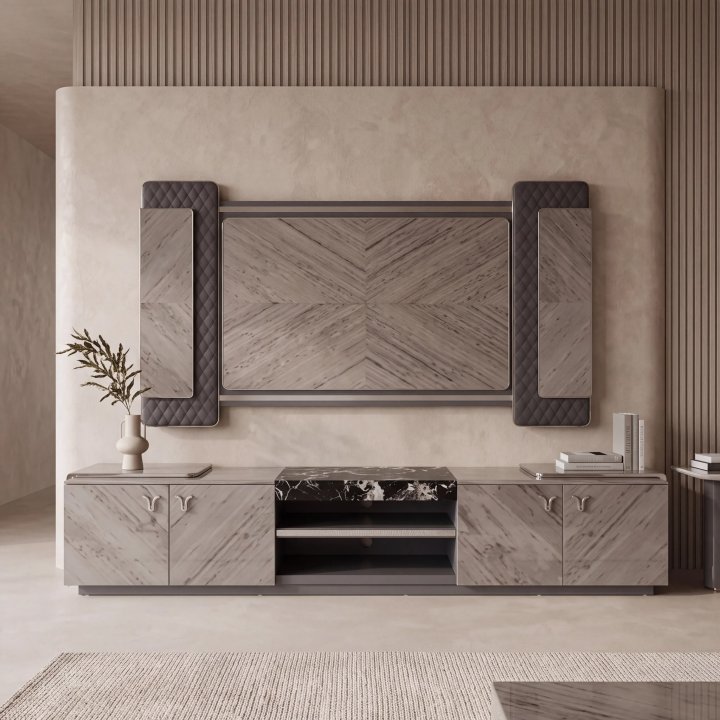
Lüks TV ünitesi seçimi, salon dekorasyonunda en çok kafa karıştıran kararlardan biri.
Choosing a luxury TV unit is one of the most confusing decisions in living room decoration. That's because a TV unit isn't just a piece of furniture the television sits on; it's the main piece that catches your eye the moment you enter the room and defines the character of the living room. On one side there are wall-mounted, floating or floor-to-ceiling wall panel systems. On the other, there are console-type units that stand on the floor, sit low and look like true furniture. Both can look beautiful, and both can be an expensive investment. So which one suits your living room?
In this guide we approach the subject around the question "wall or console?" in as clear and comparative a way as possible. First we'll clarify the terms. By wall type we mean wall-mounted, floating and paneled solutions that cover the wall from end to end. By console type we mean low units that rest on the floor, mostly with drawers and doors. Decorative mirror-and-console sets in the entrance hall or dining room are outside this topic; we'll only touch on them in terms of the living room's overall cohesion.
We make the comparison according to criteria that will genuinely help you in daily life: living room size, wall length, visual impact, storage, cable management, TV size, the wall's load-bearing capacity, flexibility when moving house, and cleaning. We'll also look at material options such as lacquer, natural wood, marble, glass and metal details, as well as lighting. We'll explain with example scenarios which option makes more sense for which lifestyle. Harmony with the seating group, the advantages of custom-size production and the importance of working with an interior architect are also covered in the article. Our aim isn't to tell you "this one is definitely better," but to offer a framework that lets you make the right decision by looking at your own living room.
Choosing a Luxury TV Unit: Wall or Console? The Short Answer
In short: if your living room has a wide wall, you want a tidy, cohesive look and you don't like cables showing, a wall-type unit usually offers the easier solution. If storage is your priority, your wall space is limited, or there's a chance you'll move in the future, a console-type unit stays more flexible. In other words, there's no single right answer; the size of the living room and your usage habits are what decide it.
The key points that separate the two types
- Visual impact: Because a wall-type unit usually extends to the ceiling or across a large part of the wall, it gives the living room an architectural feel. A console looks lighter, and since it leaves the floor and wall open, the room can feel more spacious.
- Storage: A console has a defined volume of drawers and cabinets, giving easy access to everyday items. With a wall type, storage can be increased with side modules and upper cabinets, but this depends on the design.
- Cables and technical infrastructure: With a wall type, socket, modem and sound system cables can be hidden behind the panel. Cable routing can also be planned in a console, but the devices remain more visible.
- Installation and moving: Floating and paneled solutions depend on the strength of the wall and require professional installation. A console stands on the floor, so it's easier to reposition and move.
- Cleaning: If the underside of the console is open, vacuuming is easy, but dust collects on the surfaces. Since floating units have an empty space underneath, a robot vacuum passes through easily.
How does material choice affect the decision?
A lacquered surface gives a clean look in simple, modern living rooms, while natural wood is a good choice for those looking for a warm atmosphere. Marble details elevate the unit's luxurious feel, and glass and metal accents heighten the emphasis. Hidden LED lighting also noticeably changes the unit's character, in both wall types and consoles. Seeing these options side by side among TV unit models gives a much clearer idea than looking at them on a screen.
Which one for which living room?
For example, for a family with a large living room who loves hosting guests, a paneled solution covering the TV wall from end to end can provide both order and impact. For someone living in a small apartment, who changes furniture often or rents, a low console makes more sense. If you're into home cinema, sound systems are easier to manage with wall-type solutions. In a home with children, a console with doors stays practical for hiding scattered toys and game consoles. In short, your lifestyle is the deciding factor.
Harmony and custom sizing
When choosing a unit, you also need to take the seating group, coffee tables and curtains into account. Viewing distance and eye level matter too; it's often recommended that the center of the screen be close to eye level when you're seated. If standard sizes don't fit your wall exactly, custom-size production offers a big advantage. Working with an interior architect at this point also makes things easier; STARMOBİ's interior architecture service is one of the standout options for those who want to plan the living room as a whole.
There's also an element of trust on the brand side: STARMOBİ's history began with manufacturing in 1981, the first showroom opened in 1990, and in 1998 it moved into Masko and continued operating under the MEP umbrella. You can review this structure on the MEP certificate page.
If you're at the decision stage, we recommend seeing the models in person at the STARMOBİ Masko showroom; seeing texture, color and size up close often makes the decision easier. If you'd like a custom design proposal based on your living room's dimensions, contact us through the contact page.
What Do Wall-Type and Console-Type TV Units Mean?
The short answer is: neither is better for every living room. If you have a wide wall and want a simple, spacious-looking living room, a wall type usually makes more sense; if you value storage space and a furniture presence, a console type usually does. What really decides it is the size of the living room and how you live at home.
Let's clarify the terms first, because the market uses different names for the same thing.
Wall-type TV unit
Units that are mounted on the wall, float, or are paneled to cover the wall from end to end fall into this group. The TV usually sits on the panel, with the cables staying behind. Because the floor looks empty, the room feels larger. In return, the wall's load-bearing capacity and correct installation become important. If a heavy unit or a large TV is involved, the job should be left to a professional.
Console-type TV unit
What we mean here are low units that stand on the floor and look more like furniture. They have drawers, closed compartments and open shelves. The TV is either placed on top or mounted on the wall behind it. They're also easy to move; you don't have to deal with dismantling them when you move to a new home.
Decorative mirror-and-console sets used in the entrance hall or dining room are a different category, and we're not discussing them here. Let's just note that they should be in harmony with the overall feel of the living room.
In the luxury segment, both types come in lacquer, natural wood, marble, glass and metal-detailed versions. In STARMOBİ's TV unit collections you can also see models close to both the wall and console approaches. Fixing these two definitions in your mind first will make the comparisons that follow much easier to follow.
Choosing a TV Unit by Living Room Size and Wall Length
Let's clarify the terms first. Here, by "wall type" we mean units that are wall-mounted, floating or paneled to cover the wall from floor to ceiling. "Console type" refers to units that stand on the floor, sit low and look like furniture. When deciding, the first thing to look at should be the size of the living room and the length of the wall the TV will be placed against.
In large living rooms
In homes with long walls and spacious living rooms, wall-type units work very well. A panel covering the entire wall can bring the TV, bookcase, hidden cabinets and lighting together in a single composition. In a large space, a small console can sometimes get lost. But this isn't a strict rule; if you want a simple, calm look, a long console on a wide wall can also look very elegant.
In medium and small living rooms
If the wall is around 2.5 to 3 meters, or the living room is narrow and long, floating units make the space look larger because they leave the floor open. Vacuuming also becomes easier. On the other hand, if storage is a big concern even in a small living room, a floor-standing console with drawers can serve you better. Here you need to set your own priority between visual lightness and practical needs.
Things to watch when measuring
- Rather than spreading the unit across the entire wall, leaving some margin on the sides generally looks more balanced.
- Viewing distance varies with TV size; take the gap between the seating group and the screen into account.
- Doors, windows, columns and socket locations can limit the unit's width.
If the wall dimensions don't really suit standard products, custom-size production makes things much easier here. Planning with an interior architecture service also lets you solve details such as cable routes, lighting and seating arrangement from the start. Keeping your living room's measurements with you while browsing TV unit models makes the job easier.
If you'd like to see the models in person, you can visit STARMOBİ's MEP-certified Masko showroom, or contact us through the contact page for a custom design proposal based on your living room's dimensions.
The Advantage of a Wall-Type Unit in Large Living Rooms
As the living room gets bigger, so does the empty wall in front of you. A small console easily gets lost in the middle of that wall, and the space beside it stands out. A wall-type unit is one of the most common ways to solve this imbalance, especially in large living rooms. It wouldn't be right to say which one is definitively better, but there are points where the wall type stands out in larger spaces.
Continuity Along the Wall
Wall-mounted, floating or floor-to-ceiling paneled units let you use the wall as a single continuous surface. A panel extending up to the ceiling makes even a wall of eight to ten square meters look orderly. In this kind of arrangement, the TV sits within the panel; closed cabinets, open shelves or display sections can be placed on the sides. The result isn't a pile of furniture, but a surface that looks like part of the architecture. When you talk to interior architects, this is the recommendation you'll hear most often for large living rooms.
An Open Floor Means More Spaciousness
With floating units the floor stays visible, so the room is perceived as larger. A robot vacuum passes underneath easily, and cleaning becomes simpler. The console type, meanwhile, is a floor-standing option with a strong furniture character; it remains a reasonable alternative if storage needs are high and there's doubt about the wall's load-bearing capacity.
Cables and Technical Infrastructure
In large living rooms, a sound system, modem and several devices work together. Leaving a cable channel behind the panel keeps this clutter out of sight. Socket and data points need to be planned before the furniture is made; adding them later is both troublesome and gives a weak result visually.
Materials and Lighting
On large surfaces, material choice comes to the fore. Lacquer gives a clean, modern look, natural wood adds warmth, and marble or glass details strengthen the feeling of luxury. Slim metal strips and hidden LED lighting keep a large wall from looking heavy. STARMOBİ's TV unit collections include paneled and floating models of this kind; you can see different surface combinations side by side according to the tone of your seating group.
What to Watch During Installation
With a wall-type unit, the real work starts with the structure of the wall. Plasterboard, brick and reinforced concrete walls each require different reinforcement, so always leave installation to a professional team. If you're thinking of moving, remember that a console is more flexible when it comes to relocating.
If your living room is large and you're setting up a long-term arrangement, made-to-measure production also makes a difference. STARMOBİ's history, which began with manufacturing in 1981, and its MEP-certified Masko showroom make it easier to see models in person for projects like these. To finalize your plan, you can share your living room measurements through the contact page and request a custom design proposal.
Console-Type Units in Small and Medium Living Rooms
If your living room is around 18-25 square meters and the wall where the TV will go isn't very long, a console-type unit is often a comfortable choice. These floor-standing, low, furniture-like units don't make the room feel smaller; on the contrary, they give it a seating arrangement. Because wall-type units can cover the entire wall, they can feel heavy in a small living room. A console, on the other hand, offers a light line that doesn't tire the eye.
Balancing visual spaciousness and storage
The biggest plus of a console is that it leaves space above and around it. Part of the wall stays open, making room for a painting, mirror or light fixture. On the storage side it's not a unit to underestimate either: the drawers and closed compartments at the bottom comfortably hold everyday items such as remote controls, game consoles, throws and documents. For someone with lots of books or collectibles, however, a wall type offers more shelving. Here you need to look at your needs.
Cables, TV size and viewing height
Cable management is relatively easy with a console. The modem, sound system and sockets can be hidden at the back or in closed compartments, and small cable openings can be left at the back. Whether the TV sits on top of the console or is mounted on the wall, it's important that it's at a height close to eye level. As a general guide, when you're seated, the center of the screen should be roughly level with your eyes. A low console fits most seating groups in this respect. If you put a very large TV on top of a small console, the proportions are off, so choose the unit's width according to the screen.
Installation, moving and cleaning
A console puts no load on the wall. You won't have weight concerns with plasterboard or a thin wall. When you move, you take it with you and place it in another corner of your new home. In models with an open base, it's easy to get the vacuum underneath, but watch out for thin recesses that trap dust.
Material and surface options
Lacquered surfaces give the living room a modern, clean look. Natural wood adds warmth, while a marble top strengthens the feeling of luxury. Glass shelves and metal details add lightness, and hidden LED lighting changes the unit's presence in the evening hours. STARMOBİ's console solutions of this kind are also among the TV unit models; the brand's presence at Masko since 1998, operating under the MEP umbrella, also offers reassurance to those who want to see the products in person.
If your living room's size isn't standard, custom-size production is useful here. You can have the console's length, depth and drawer layout designed for the room. Planning with an interior architect also lets you resolve harmony with the seating group, curtains and lighting from the start. STARMOBİ's interior architecture service can help at this point.
If you'd like to see the models before deciding, you can visit STARMOBİ's Masko showroom or request a custom design proposal based on your living room's dimensions through the contact page.
Visual Impact and a Sense of Space: How Does Each TV Unit Make the Living Room Look?
When you enter the living room, the first place the eye lands is usually the TV wall. That's why choosing a unit isn't only about where you'll put the television; it also shapes the overall atmosphere of the room. By "wall type" here we mean wall-mounted, floating or floor-to-ceiling paneled units; by "console type" we mean units that stand on the floor, sit low and look like furniture.
The Atmosphere Wall-Type Units Bring to the Living Room
With paneled or floating units, the floor stays visible, so the room is perceived as larger than it is. This difference is especially noticeable in medium-sized living rooms. In a floor-to-ceiling wall-clad design, the TV looks like part of the wall; cables, cabinets and open shelves all disappear into the same composition. The result is an orderly, calm look. In return, the wall surface becomes completely "filled," which can feel a little heavy if you don't have a very wide wall.
The Warmth of Console-Type Units
A low console, on the other hand, gives the living room more of a furniture feel. A vase, lamp or stack of books placed on top makes the room look lived-in and warm. Because most of the wall stays empty, it makes room for a painting, mirror or lighting. Since the floor-standing body partly covers the floor, the sense of space may be slightly less; but depending on the size of the living room, this isn't much of a problem.
Materials and Light Make a Difference
The same model looks completely different depending on its surface. Glossy lacquer surfaces reflect light and open up the room, natural wood brings warmth, and marble-patterned or marble-detailed surfaces give a more striking result. Glass doors and metal details add lightness. LED lighting is also an important part of the equation; hidden strip lighting makes a floating unit look as if it's hovering in the air. Seeing different combinations of these surfaces among the TV unit models helps you pin down the atmosphere you have in mind.
A Short Guide
- If the living room is small or medium-sized, a floating or paneled unit generally supports a sense of space.
- If the wall is wide and the seating group has a distinctive character, a console can look more balanced.
- Dark, matte surfaces add depth; light, glossy surfaces make the room feel larger.
It's impossible to say which is "better"; both give very elegant results when properly planned. STARMOBİ collections include examples of both styles. If you want to decide based on your living room's size and seating group, you can request a custom design proposal through the contact page or see the models in person at the showroom at Masko.
A Simple, Architectural Look With a Wall-Type Unit
When we say wall-type TV unit, we think of paneled structures that are mounted on the wall, float, or extend from ceiling to floor. In these models the floor stays visible, so the living room is perceived as lighter and larger. If you're looking for that clean "architectural" line in a luxury living room, a wall-type unit often does the job.
Spaciousness and Visual Impact
There's a gap under a floating unit; a vacuum or robot passes through easily, and the eye sees the floor from end to end. In small and medium-sized living rooms, this difference is felt immediately. In large living rooms, a floor-to-ceiling paneled wall gives the room a backdrop effect. The TV and unit look like a single whole, and the screen appears to emerge from within the wall. Simple, paneled designs of this kind are also among the TV unit models.
Cables, Infrastructure and Installation
The biggest plus of the wall type is its ability to hide cables. Socket, modem, sound system and HDMI lines run behind the panel, and you won't see a single cable in sight. But there's a condition: the plan needs to be made from the start. Socket points can't easily be moved later.
The structure of the wall also matters. Brick, concrete block and plasterboard each require different fixings. Don't guess the load-bearing capacity; ask the installation team and, if necessary, an interior architect. If a large screen and a heavy unit are involved, this check is essential.
Materials and Lighting
Lacquered surfaces give a clean look in modern living rooms. Natural wood adds warmth, while marble-patterned panels produce a more striking result. Glass shelves and metal details add lightness to the design. LED lighting also gives the wall depth in the evening hours; indirect light that doesn't strain the eyes generally gives a better result.
Points to Watch
When it comes to storage, the wall type can sometimes be limited. Drawers and closed sections can be added, but there are also models that offer less space than a console. Dismantling the panels when moving and recreating the same arrangement in a new home can also take time. That's why you can decide more easily if you'll be staying in the same home for a long time.
Getting support from an interior architecture service to determine the right dimensions for your living room reduces both unnecessary costs and surprises later on.
The Furniture Character of a Console-Type Unit
A console-type unit stands as a low piece of furniture on the floor rather than being hung on the wall. That's why it's perceived in the living room not as "wall cladding," but as a true piece of furniture. The texture of the wood, the gloss of the lacquer or the weight of a marble top directly adds character to the room.
Visual impact and surface options
A low profile makes the living room look more spacious than panels extending up to the ceiling. This difference is especially noticeable in rooms where wall length is limited or the ceiling isn't high. There's a wide range of surface options: matte or glossy lacquer gives a modern presence, natural wood brings warmth, and marble or glass details bring the unit closer to a showpiece. Slim metal legs and frames make the unit look slightly raised off the floor. Hidden LED lighting also changes the look of both the unit and the wall behind it in the evenings.
Pros and things to watch in daily use
- Storage: Drawers and closed compartments offer ample space for remote controls, game consoles, books and decorative objects.
- Cables and technical infrastructure: The modem, sound system and media players can be placed inside the body. Cable openings and ventilation gaps at the back should be planned.
- Installation and moving: There's no concern about the wall bearing a load. It's also easy to reposition without dismantling when moving.
- Cleaning: Models with an open base and back are easy to vacuum around, but dust can show more quickly on the top surface.
If you're going to place the TV on the unit, the viewing height should be considered together with your seating group. On a very low console, the screen can end up below eye level; that's why many people prefer to mount the TV on the wall and place a console underneath.
Color and material harmony with the seating group is more pronounced here. When the tone of the unit speaks to the wooden legs of the sofa, the living room looks cohesive. STARMOBİ's TV unit collections include console models of this kind. If size is an issue, custom production and interior architecture support make things easier.
Conclusion
There's no single answer to the wall-type or console-type question that applies to everyone. Wall-type units (floating, wall-mounted or floor-to-ceiling paneled solutions) give the living room an orderly, architectural look and also offer an advantage in hiding cables. In return, issues such as the structure of the wall, installation requirements and reinstallation if you move need to be taken into account. Console-type units stand out with their furniture character, ease storage and can easily be repositioned. They can also give a sense of space where wall length is limited or the ceiling is low.
A few simple questions clarify the decision. Is your living room large with an empty wall, or is space tight? Do you have a lot of belongings, or do you want a simple look? If you rent or move often, a console may be more convenient. In a home where you'll stay for a long time, you may want to design the entire wall as a single piece. TV size, viewing height, socket and sound system locations, and harmony with the seating group also need to be put into the equation. On the material side, choosing lacquer, natural wood, marble, glass and lighting details according to the living room's overall atmosphere gives good results.
If the dimensions don't fit exactly, custom production makes a real difference. Planning with an interior architect ensures that details from cable routes to lighting are thought through from the start. With its history that began with manufacturing in 1981, its first showroom in 1990 and its operation at Masko under the MEP umbrella since 1998, STARMOBİ is one of the options you can turn to in this area.
If you'd like to see the models in person, you can examine them at the showroom at Masko. For a custom design proposal based on your living room's dimensions, contact us through the contact page. Bringing measurements and a few photos with you speeds up the conversation.
Updated: November 2026